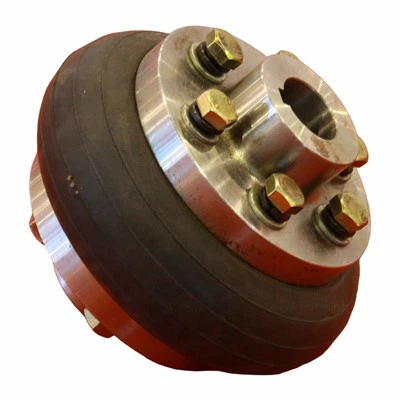
As a supplier of Spring Taper Grid Couplings, I often get asked if these couplings can be used in high - speed applications. It's a valid question, and today I'm going to break it down for you.
Let's start with what a Spring Taper Grid Coupling is. It's a type of coupling that uses a grid spring to transmit torque between two shafts. The spring is designed to absorb shock and vibration, which is great for protecting your equipment. The taper design allows for easy installation and removal, making maintenance a breeze.
Now, when it comes to high - speed applications, there are a few factors we need to consider. First off, the balance of the coupling is crucial. In high - speed operations, even the slightest imbalance can cause significant vibrations, which can lead to premature wear and tear on the coupling and the connected equipment. Our Spring Taper Grid Couplings are precision - balanced during the manufacturing process. This ensures that they can operate smoothly at high speeds without causing excessive vibrations.
Another important factor is the material of the grid spring. We use high - quality materials that can withstand the high centrifugal forces generated at high speeds. These materials are also resistant to fatigue, which means the spring can maintain its integrity over a long period of use. The grid spring is the heart of the coupling, and its performance directly affects the overall performance of the coupling in high - speed applications.
The design of the coupling also plays a role. Our Spring Taper Grid Couplings have a compact and lightweight design. This is beneficial in high - speed applications because it reduces the inertia of the rotating parts. Lower inertia means less energy is required to accelerate and decelerate the shafts, which can lead to more efficient operation.
But don't just take my word for it. There are real - world examples of Spring Taper Grid Couplings being used in high - speed applications. For instance, in some high - speed industrial machinery, these couplings have been used to connect motors to pumps or compressors. They have proven to be reliable and efficient, even under demanding conditions.
However, it's not all smooth sailing. There are some limitations to using Spring Taper Grid Couplings in high - speed applications. One of the main limitations is the maximum speed rating. Every coupling has a maximum speed at which it can operate safely. If you exceed this speed, the coupling may fail, which can cause serious damage to your equipment. It's important to carefully consider the speed requirements of your application and choose a coupling with an appropriate maximum speed rating.
Another limitation is the torque capacity. In high - speed applications, the torque requirements can be quite high. Our Spring Taper Grid Couplings are designed to handle a certain amount of torque, but if your application requires more torque than the coupling can provide, you may need to look for an alternative solution.


Now, let's talk about some alternatives that might be suitable for high - speed applications. One option is the Flexible Flanged Grid Coupling. This type of coupling offers similar benefits to the Spring Taper Grid Coupling, but it has a different design that may be more suitable for some high - speed applications. It has a flanged design that provides a more secure connection between the shafts, which can be beneficial in high - speed operations.
Another alternative is the High - speed Snake Spring Coupling. This coupling is specifically designed for high - speed applications. It has a unique snake - shaped spring that provides excellent shock absorption and torque transmission capabilities.
The Grid Lign Coupling is also worth considering. It has a different grid design that can offer better performance in high - speed applications. It's known for its high torque capacity and durability.
So, can a Spring Taper Grid Coupling be used in high - speed applications? The answer is yes, but with some caveats. It's important to carefully evaluate your application's requirements, including speed, torque, and operating conditions. If the Spring Taper Grid Coupling meets your needs, it can be a great choice. But if not, there are other options available.
If you're in the market for a coupling for your high - speed application, I encourage you to reach out to us. We have a team of experts who can help you choose the right coupling for your specific needs. We can provide you with detailed information about our products, including their performance characteristics and limitations. Whether you decide to go with a Spring Taper Grid Coupling or one of the alternatives, we're here to assist you every step of the way.
In conclusion, while Spring Taper Grid Couplings have their limitations in high - speed applications, they can still be a viable option in many cases. By understanding the factors involved and making an informed decision, you can ensure that your equipment operates efficiently and reliably. So, don't hesitate to contact us if you have any questions or if you're ready to start the procurement process.
References
- Machinery's Handbook, 31st Edition
- Coupling Technology Handbook by John E. Shigley and Charles R. Mischke